BLUF: The Development Support Visa Vanuatu is a temporary work visa – not to be confused with the Development Support Program (CBI). It requires a nomination from an approved government agency or NGO / non-profit, costs 10,300 VUV (~£70 GBP) for individuals, is valid for maximum period of 5 years with multiple entry, and allows legal development-related work. Unlike the standard tourist eVisa, the Development Support Visa offers employment rights and a pathway toward Permanent Residency after extended lawful residence.
This guide was researched by Pacific island immigration consultants with 8 years of experience in Vanuatu residency pathways. Last updated: March 2026. This article is for informational purposes only and does not constitute legal advice. Always consult the Vanuatu Department of Immigration or a qualified migration agent before applying.
What Is the Vanuatu Development Support Visa & Who Is Eligible?
BLUF: The Development Support Visa is a temporary work visa valid for up to 5 years, costing 10,300 VUV (~£70 GBP).

According to Section 12(3) of the Vanuatu Immigration Act [Cap. 66], the Development Support Visa Vanuatu requires a formal nomination from a government agency as defined in Schedule 4. Eligible roles include official, employee, consultant, adviser, expert, or volunteer contributing to a development-oriented program.
- You must not engage in any employment outside the approved development project.
- You cannot switch to another visa category while in Vanuatu.
- Extensions are conditionally permitted by the Immigration Department – not via the online portal.
- Secondary applicants (accompanying dependants) are permitted.
Development Support Visa Fees & Costs (2026)
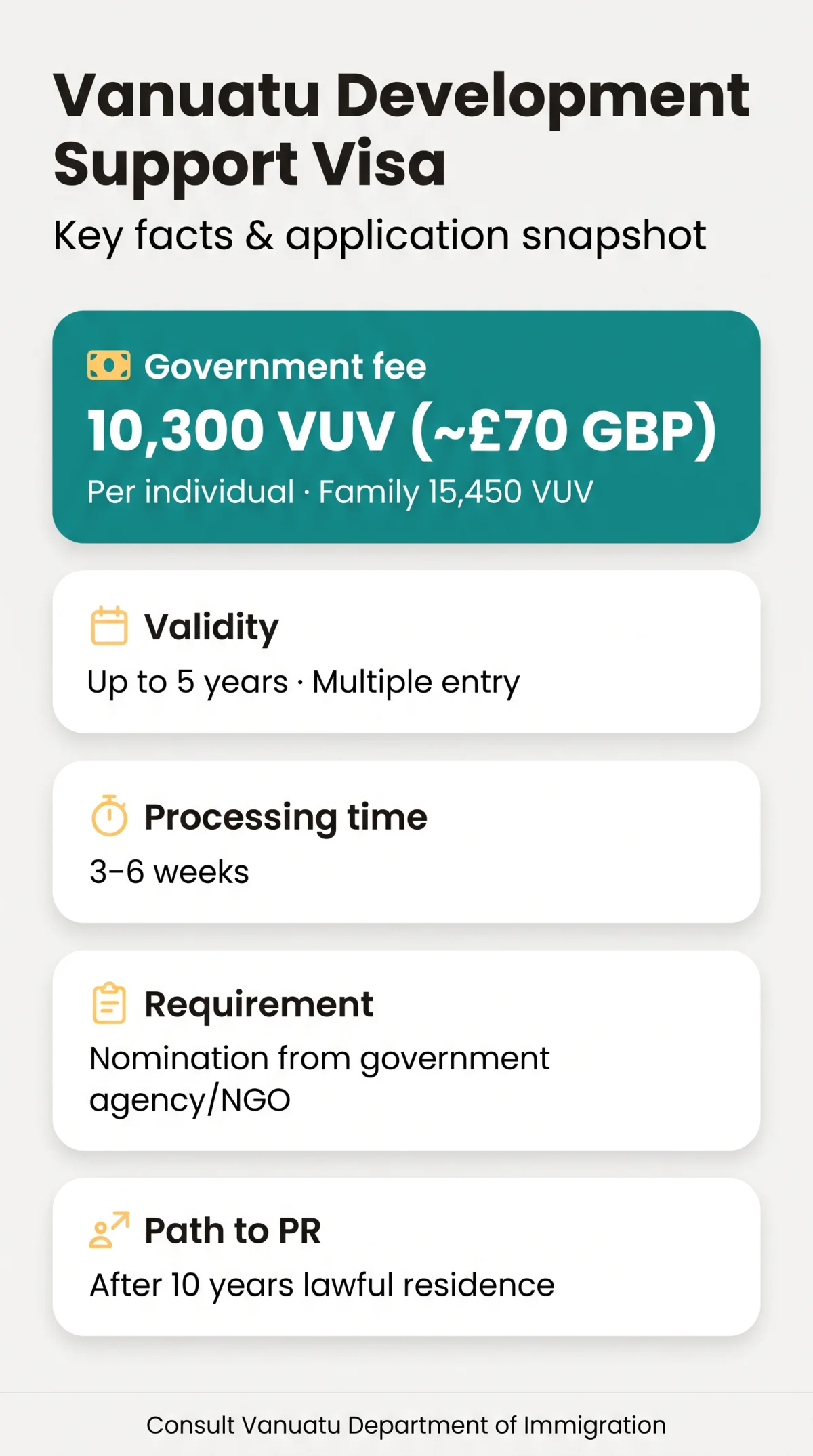
BLUF: The Development Support Visa government fee is 10,300 VUV (~£70 GBP) per individual or 15,450 VUV for a family of four, with UN agency staff exempt.
UN agency staff can waive the Development Support Visa Vanuatu fee by providing an exemption letter from MFAICET (contact: +678 33180). Budget extra for hidden costs not included in the government fee, such as medical exams, a police certificate, and translation fees.
| Fee Component | Cost in VUV | Cost in GBP (Approx.) |
|---|---|---|
| Individual Application | 10,300 VUV | ~£70 GBP |
| Family of 4 | 15,450 VUV | ~£105 GBP |
How to Apply for the Development Support Visa: Process & Documents
BLUF: Application requires securing a nomination letter, gathering certified copies, and submitting via the eVisa portal or Port Vila immigration office, with processing estimated at 3-6 weeks.
John, a UK‑based engineer, applied for the Development Support Visa Vanuatu in January 2026. He shared that the nomination letter took two weeks to obtain and the entire process was completed in five weeks.
Secure a nomination letter
Obtain formal approval from a recognised Vanuatu government agency or non-profit entity.
Gather certified copies
Prepare all required documents, including a medical examination report and a police certificate for applicants over 18.
Submit the application
Lodge the documents online via the Vanuatu eVisa Portal or submit them in person at the immigration office.
Kumul Highway, Tamarama Building, Port Vila, Vanuatu
Po Box 9092
Phone: (+678) 22354
Email: [email protected]
Hours: Mon-Fri 8:00am – 17:00pm
Benefits of the Vanuatu Development Support Visa & Pathway to Permanent Residency
BLUF: Holding the Development Support Visa offers up to 5 years of multiple-entry residency, 0% income tax, and a direct path to permanent settlement after 10 years.
The Development Support Visa Vanuatu grants approved applicants multiple entry privileges, family inclusion, and access to a zero percent income tax system. After 10 years of lawful continuous residence plus business ownership, you may qualify for the Permanent Investor Visa, which requires a government fee of 3,090,000 VUV.
Development Support Visa vs Standard eVisa – Key Differences
BLUF: The Development Support Visa costs 10,300 VUV, is valid for 5 years with multiple entries and work rights; the eVisa costs 5,150 VUV, single entry, 120 days, no work.
The standard tourist eVisa strictly prohibits any employment, commercial, or business activities. Processing for the Development Support Visa Vanuatu takes 3-6 weeks. Budget extra for medical exams, police clearance, and translation fees (not included in the 10,300 VUV government fee).
| Feature | Development Support Visa | Standard eVisa |
|---|---|---|
| Purpose | Approved development projects | Tourism only |
| Cost | 10,300 VUV | 5,150 VUV |
| Validity | Up to 5 years | 120 days (4 months) |
| Entry Type | Multiple entry | Single entry |
| Work Rights | Allowed (nominated role only) | Strictly prohibited |
Development Support Visa vs Development Support Program (DSP) – Don’t Confuse Them
BLUF: The Development Support Visa is a ~£70 GBP temporary work visa; in contrast, the Development Support Program (DSP) is a CBI scheme requiring a minimum $130,000 USD donation.
Prospective applicants must not confuse the two distinct pathways in 2026. The Development Support Visa Vanuatu functions as a temporary work visa. Conversely, the DSP operates strictly as a Citizenship by Investment (CBI) scheme, granting citizenship rather than temporary employment rights. A couple applying for the DSP faces a minimum cost of $150,000 USD (non-refundable donation).
| Feature | Development Support Visa Vanuatu (DSV) | Development Support Program (DSP) |
|---|---|---|
| Purpose | Temporary development work | Citizenship by Investment (CBI) |
| Individual Cost | 10,300 VUV (~£70 GBP) | $130,000 USD (minimum donation) |
| Family Cost | 15,450 VUV (family of 4) | $150,000 USD (couple) |
Development Support Visa for UK Citizens (2026)
BLUF: UK citizens can enter Vanuatu visa-free for tourism (up to 120 days), but the Development Support Visa requires prior nomination regardless of nationality and does not exempt holders from UK HMRC tax obligations.
UK citizens can enter Vanuatu visa-free for tourism (up to 120 days), but the Development Support Visa requires prior nomination regardless of nationality and does not exempt holders from UK HMRC tax obligations. British expats holding a Development Support Visa Vanuatu must assess their ongoing tax liabilities under the UK HMRC Statutory Residence Test, as local tax exemptions do not automatically cancel UK reporting obligations. Furthermore, comprehensive health and medical evacuation insurance is essential because the NHS provides no coverage in Vanuatu. See also the UK Foreign Office travel advice for Vanuatu (gov.uk).
Frequently Asked Questions About the Vanuatu Development Support Visa
BLUF: The most common Development Support Visa questions cover cost (~£70 GBP), processing time (3-6 weeks), visa-switching rules (not permitted), and the indirect pathway to citizenship through permanent residency.
What is the Vanuatu DSV processing time?
The estimated processing time for the Development Support Visa Vanuatu is between 3 to 6 weeks. Applicants should submit their application form and required documents, such as a police certificate and medical examination report, well in advance of their intended travel date.
Can I switch from a Development Support Visa to another visa type?
No, you cannot switch from a Development Support Visa to another visa category while in the country. Visa status changes are strictly not allowed. If you wish to apply for a different visa, you must depart and reapply via the official eVisa portal (evisa.gov.vu) or by visiting the Vanuatu Immigration Office in person.
Can my spouse work on a dependent DSV in Vanuatu?
Employment rights for dependants are not automatically granted; confirm with the Vanuatu Department of Immigration regarding work permissions for dependants included on your Development Support Visa Vanuatu.
Do UK citizens need a visa for Vanuatu tourism?
UK citizens do not need a visa for tourist stays up to 120 days. For development work, the Development Support Visa Vanuatu is mandatory. Dependants included on your DSV have no automatic work rights – you must confirm with the Vanuatu Department of Immigration.
Is health insurance required for the Development Support Visa?
Health/evacuation insurance is strongly recommended. The UK NHS does not provide coverage in Vanuatu, and the remote location makes private medical evacuation insurance essential for all applicants.
What happens if my Development Support Visa application is refused?
If your Development Support Visa application is refused, there is no formal appeal process available. Applicants will need to either submit a new application with corrected documentation or contact the Vanuatu Department of Immigration directly at [email protected] for further clarification.
How much does it cost to get permanent residency in Vanuatu?
Obtaining permanent residency through the Permanent Investor Visa costs 3,090,000 VUV. To qualify for this pathway, you must have been lawfully and continuously residing in Vanuatu for at least 10 years, plus business ownership, which can be initially facilitated by holding a Development Support Visa.
Can I apply for the Vanuatu DSV online?
Yes, you can submit your application and required documents for the Development Support Visa Vanuatu online via the official eVisa portal at evisa.gov.vu. Alternatively, applications can be submitted in person at the Port Vila immigration office.